Sword of the Stars

Preview
Breaking the conventions
by Sergio Brinkhuis
previewed on PC
Building your empire
You'll build and plan your empire on a 3D map of the galaxy. This part is fully turn-based and will give you the ability to determine your course of action as you go. The developers are trying to keep the player from having to micromanage too much and have implemented some helpful tools to facilitate this. These tools include, for example, pie-charts that allow the player to quickly change the focus of the entire empire from research to production rather than having to set this planet by planet.
Speaking of research, this is another area with a twist. No matter whether you play Galactic Civilizations, Master of Orion or Civilization IV, research has always been pretty straightforward. Some technologies require others before you can start working on them and you pretty much go through it the same way every time. Not so in the Sword of the Stars. The game offers technologies spread over eight different categories and the techs in each category are randomly generated every time you start a new game. This makes it impossible to work out a preferred strategy and will keep the 'surprise' factor going on a lot longer.
The fat lady
Unlike the empire building, battles are waged in real time. When two fleets try to occupy the same point in space, a battle ensues. During a set time of up to 10 minutes, the fleets will have to duke it out. Before the battle starts, a 'virtual chessboard' appears on which you can determine the formation in which your ships will enter the battlefield. After this, the game switches to real time and you'll have control over your ships like you would have in any RTS game (albeit on a 3D map). This should prove fun in itself, but what happens next is what makes Sword of the Stars really unique.
You see, if one of the fleets gets defeated, you're all done. But when combat is not fully resolved after the set amount of time, things get interesting. A maximum of 30 ships of your fleet can be taken into battle. Any additional ships will have to 'wait outside'. It is also possible that new ships will have arrived at the scene when the battle finishes. When the time is up, you will be asked if you want to bring any of the waiting ships into the battle or if you want to pull out altogether. In essence, it ain't over 'till the fat lady sings. Battles can 'drag' on over several turns making the outcome far more epic and dynamic than in traditional RTS battles.
Space boring?
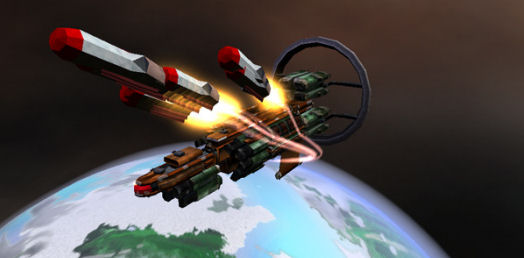
Space can be a pretty boring place. Just look up one night and all you see is black with white dots scattered around it. Sure, occasionally there's an intriguing blue and green marble floating around, but overall there's not much to see. To liven it up, Kerberos has chosen to go with fairly colorful ships, objects and backgrounds. While there are some areas in which you will feel like you're out in the middle of nowhere, there won't be many. And even then, the chances are good that you're about to be ambushed and find yourself surrounded by enemy ships. If you look at the screenshots, you'd be hard pressed to find anything that's boring.
Ships themselves will be fully customizable. Each race will have three different hull classes. While the actual hulls are pretty much set in stone, you'll be able to place all kinds of modules on them and these will influence what the hull will look like. This also means that you'll be able to judge a ship's strength based on its visible weaponry.
Pretty slick
Sword of the Stars appears to be breaking some deeply nested conventions of the genre. The battle system completely changes how we play 4x games and the dynamic research tree will ensure that you can never rely on the beaten path. If I were you, I'd keep an eye out for this one. I know I will.


