Interview with Blackmill Games, developer of Isonzo


Feature
Discussing the new "Caporetto" expansion and the development process for Isonzo
You mentioned in a recent announcement via the discussion forum that both future updates and future expansions are in the pipeline. How do you distinguish an update from an expansion? Setting aside the implication that the latter is often sold as DLC?
Jos Hoebe:
Yeah, I think expansion is typically very much a combination of levels, weapons, cosmetics, and gameplay. So I think that if you put a new update together, and it sort of has those characteristics, I would say it's an expansion.

Dan L:
So what was rolled out here, in the Caporetto update, would count as an expansion?
Jos Hoebe:
Exactly. But what’s different here is that this expansion is being rolled out somewhat in several stages. We decided to launch them up the levels, one by one, instead of in one big update to sort of bucket them out sooner.
Dan L:
This was to give yourselves some time to work on each one individually before releasing them, I'm guessing?
Jos Hoebe:
Yeah, exactly. I mean, a level takes quite a long time to make, these are quite large levels there. I mean, you've played the game. They're quite deep, quite involved, much bigger, and contain way more details, so that every level has something unique on it, whether it be a big bridge, a city, or some kind of mountain. So there's always some custom [aspect] to, to each level, which is something we didn't do in any of our other games, which [generally would have] generic fields with a trench through.
But these levels all have something that distinguishes them from the other, but [the tradeoff is that] it takes a bit more time to develop. So yeah, to call it an expansion is justified, since in Caporetto, we also added, of course, the Germans. The German faction comes with quite a lot of new weapons and units, I think a little more than 10 weapons. This equates to almost a 25% increase over the base game or something. It's significant content to date.
Dan L:
All of it giving players a reason to come back in, and get reinvested in the game hopefully moving forward.
Jos Hoebe:
Yes, exactly. Yeah.

Dan L:
I'm just kind of curious: How many people are involved in putting together a new map like Caporetto? What's that process like for you guys? Like where do you start with, you know, conceptualizing the space? Or do you just jump straight into Unity right away?
Jos Hoebe:
Because of the time period and locations, there's not a lot of literature available, outside of records of the battle itself. You of course have a couple of secondhand sources like awarded metals, and people who write about lived accounts. So picking those is, is, is a challenge in its own right. You want to do justice by representing the locations in a certain way, but also to give a unique gameplay experience. So there's a balance there.
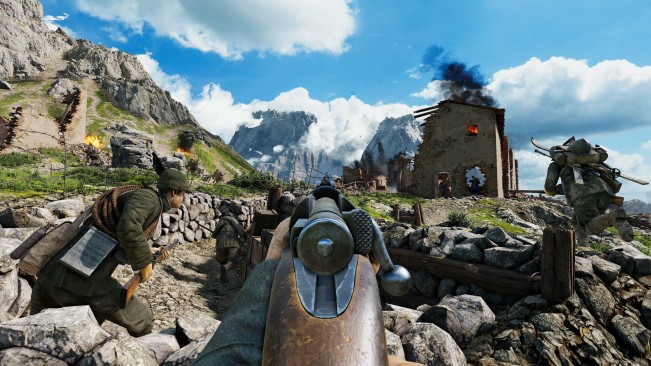
Typically, I'm the one who makes the choices of what we're going to incorporate. We try to go to the location [to gain insights] we would otherwise miss, from just looking at big-picture details. And then we form our own niche production. We have several development stages, of course. We decide on the unique assets that need to be made for the level to function, say a bridge needs to be made. And that's a separate task handled by our asset creators. Then there's a pre-production phase for the level, where we block it out. This is where we take the geo data and sort of incorporate satellite data to determine factors like the vertical height of mountains and hills.
Dan L:
So you take that GPS data, and try to base the layout for the level as closely as you can, using that information.
Jos Hoebe:
Correct. Yeah, that's a challenge. Oh, right. Because the world scales you get bigger and more boring, because the big fields are empty slopes or something, so our designers will create trenches in them and try to reconstruct the location as it was a hundred years ago, based on photos and other materials. So we do a big sweep of all the photos that are available for a certain area, and then try to incorporate that information into the map design.
Dan L:
As you say, it's tricky because we're talking about an era where photos effectively didn't exist, outside of very formal occasions, due to technical limitations.
Jos Hoebe:
Yeah, exactly. Nobody stops to take a photo during combat.
Dan L:
You're definitely not going to take a selfie while you're being, you know, bombarded by mortars.

Jos Hoebe:
Yeah, yeah. Now you see it Ukraine, that's kind of the first generation war where you can actually see people in the trenches, which is eerily similar. By the way, 100 years ago, most of the photos and footage you see are reenactments from after the war, especially the footage. I mean, if you see people going to climbing out of the trenches, there's a cameraman standing on top of the trench filming down, that wouldn't happen. So most of most footage is after the fact, but there's enough material when the battle is over, and photo photographers come in to celebrate the victory, then you have photos, or some photographer coming in to take a few propaganda photos of troops in the trenches.
Dan L:
So I’m guessing those photos, as well as like, you know, whatever, of a race, that's how you're able to get the information you need to create the uniforms to create, you know, all the other little details that you integrate into the game, I'm sure of course, the US Army and like the other, you know, militaries out there have stock photographs and museums where you can see the actual physical uniforms. And so you just integrate all that data and try to replicate as closely as you can.
Jos Hoebe:
Yeah.